
Eridan Breaks the Power-Interference Struggle
More Power Doesn’t Mean
Better Performance
Successful wireless networks optimize along two axes: increasing capacity at range and reducing interference between cells. The common way to increase capacity at range is to increase base-station power. However, this directly degrades the performance of nearby cells operating on the same frequency, commonly called co-channel interference.
Why Traditional Network Scaling Fails
Telecommunication network designers are trapped in a short-term loop. To manage demand, they typically:
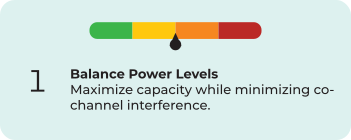
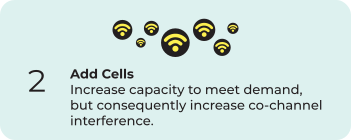
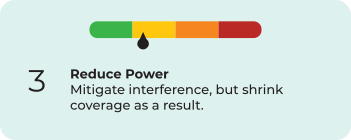
Each step solves one problem while creating another. The result: network cost scales faster than capacity.
But what if increasing capacity didn’t require increasing power,
or accepting more interference?
Equivalent Capacity with a Fraction of the Power
At Eridan, we found a different answer. It begins with delivering more usable capacity from each cell through a cleaner signal, rather than relying on additional transmit power.
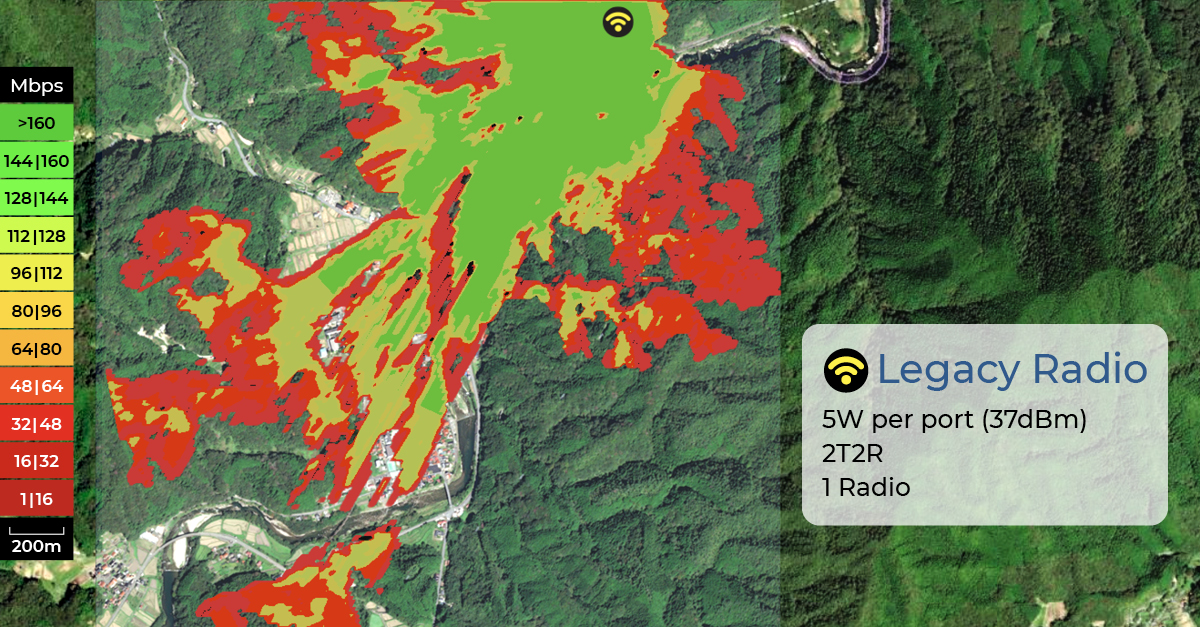
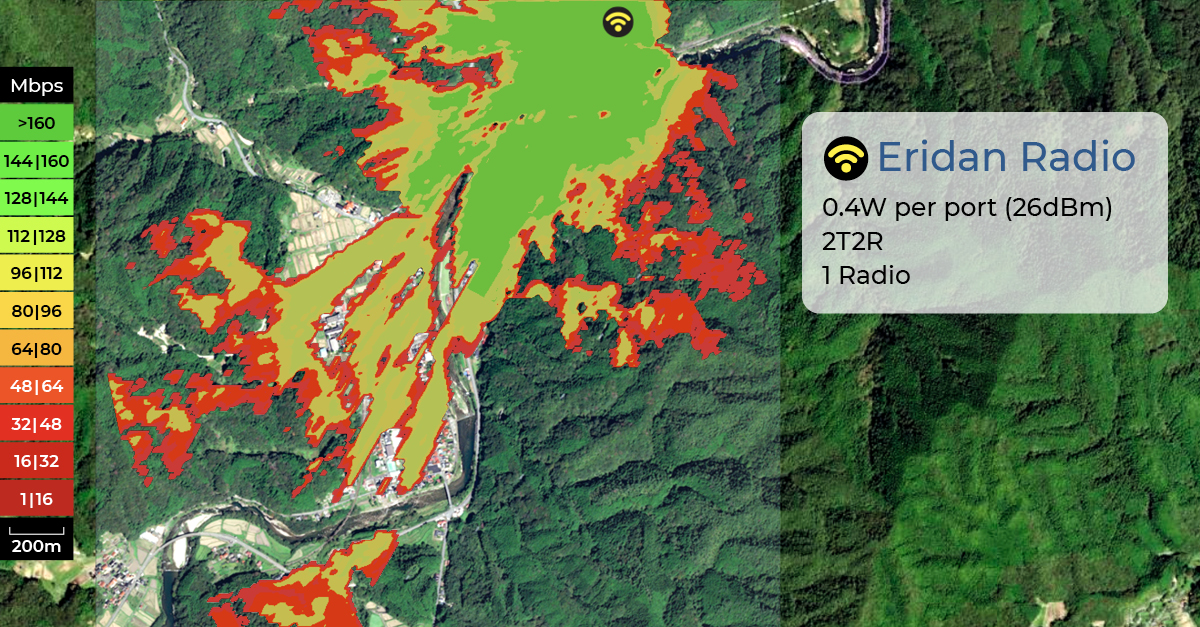
As an example, let’s use a 5W per port (37dBm) legacy radio. It relies on high output power to get high capacity at 800m range.
In comparison to the 5W per port radio, Eridan’s clean signal provides the equivalent high capacity area with just 8% of the power (0.4W or 26dBm per port). This is possible due to Eridan’s low transmitter noise which maintains higher order modulations at lower received signal levels.
Total delivered capacity per cell remains equivalent to that of a much higher-power system.
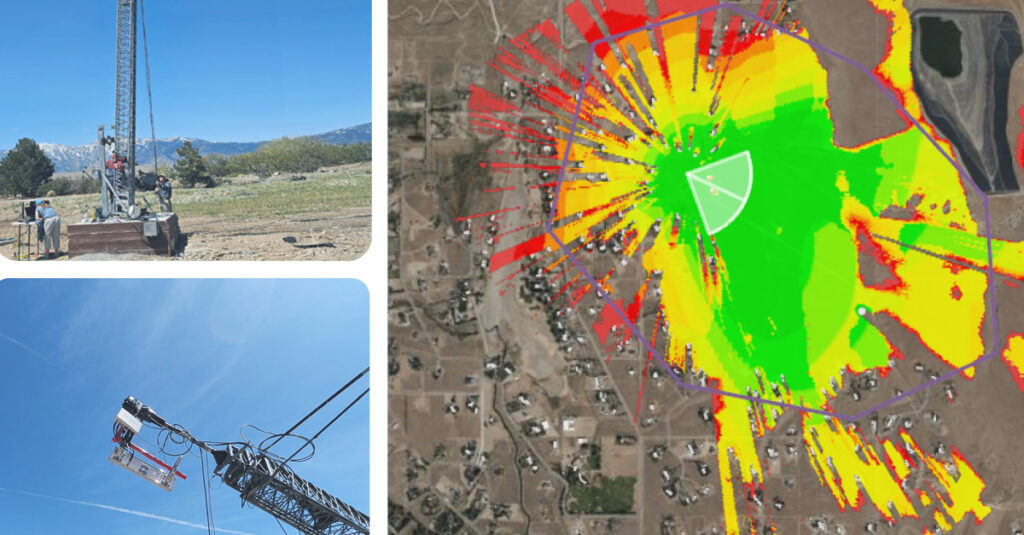
Eridan sustained over 100 Mbps at 1.7 km using just 0.3W, proving that Ultra-Clean Signal™ delivers real performance.
Learn More
Eridan’s Solution to Co-Channel Interference
Now, very few networks include only one cell. When a second cell site is deployed, that legacy radio’s high output power becomes noise for the neighboring cell. This causes co-channel interference and degrades throughput at the cell edge.
The impact extends beyond throughput. Interference can cause retransmissions and scheduling delays, increasing latency and making network performance less predictable – all a result of high output power bleeding into nearby cells.
However when deploying multiple Eridan cells, co-channel interference between them is substantially lower because of the low output power. As a result, the lower-power base stations with cleaner signals actually outperform the high-power equivalent by 22%.
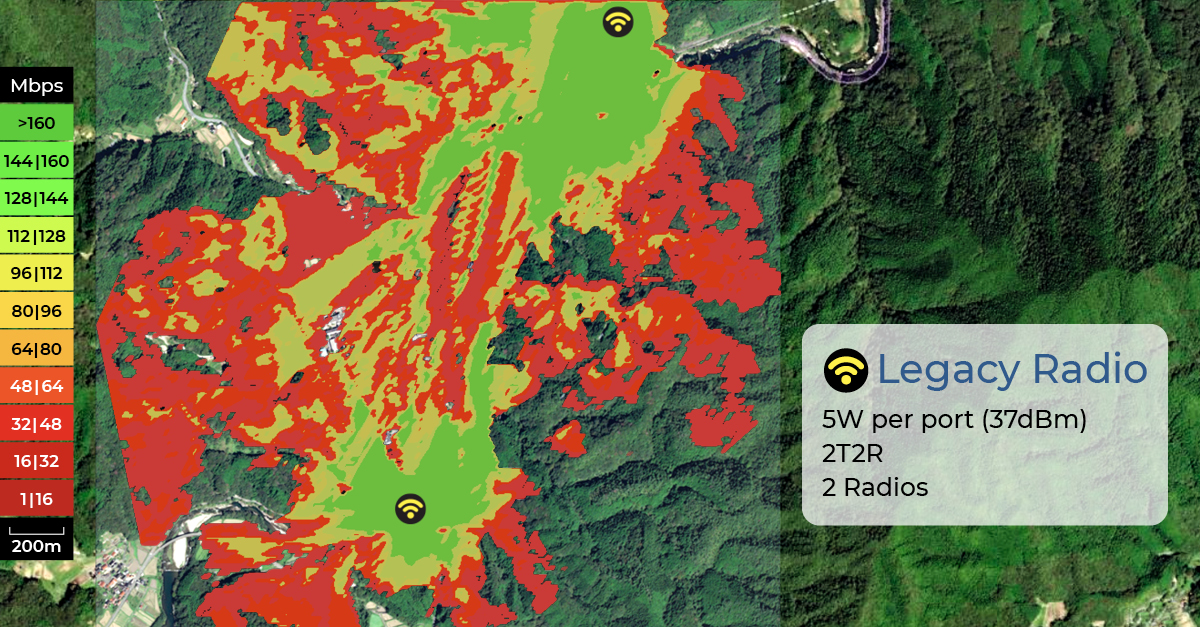
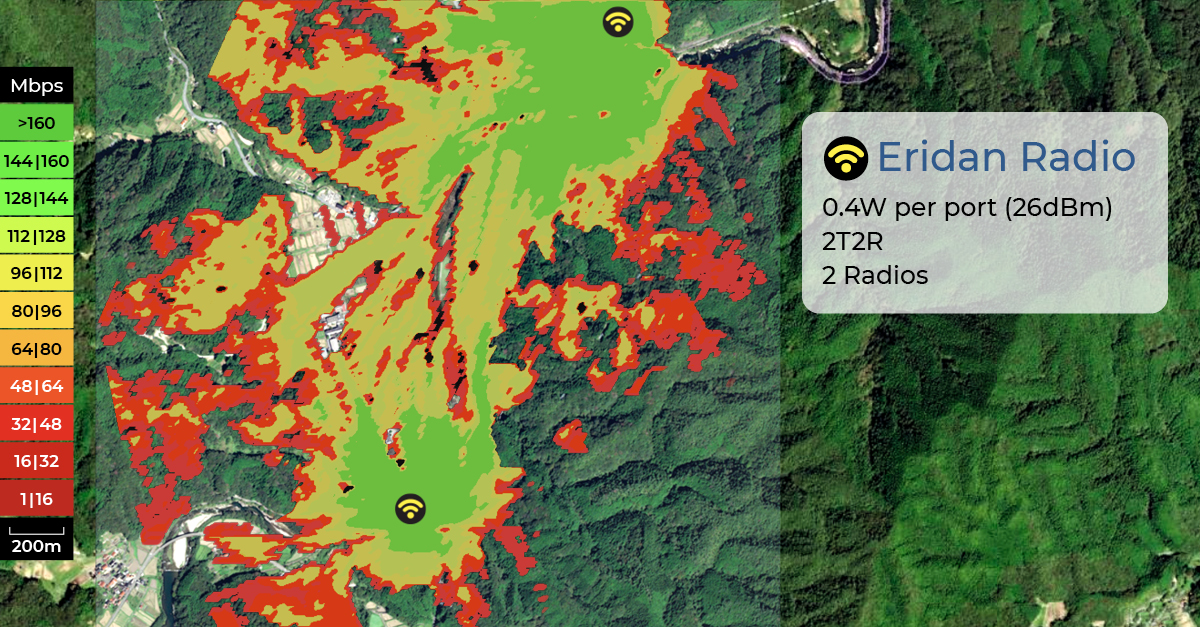

Eridan’s Advantage Grows as Co-Channel Interference is Mitigated
Network planners often respond to co-channel interference between two cells by reducing radio power. While this can limit interference between cells, it also creates another problem: shrinking the high-speed coverage area.
Taking the two cells above, legacy radios were reduced from 5W to 1W per port (30dBm), while Eridan’s All-Digital radios remained at 0.4W per port. Now Eridan provides 94% more high-capacity area than its legacy radio counterparts.
Because Eridan’s advantage comes from signal quality rather than raw power, it compounds as cell density increases.
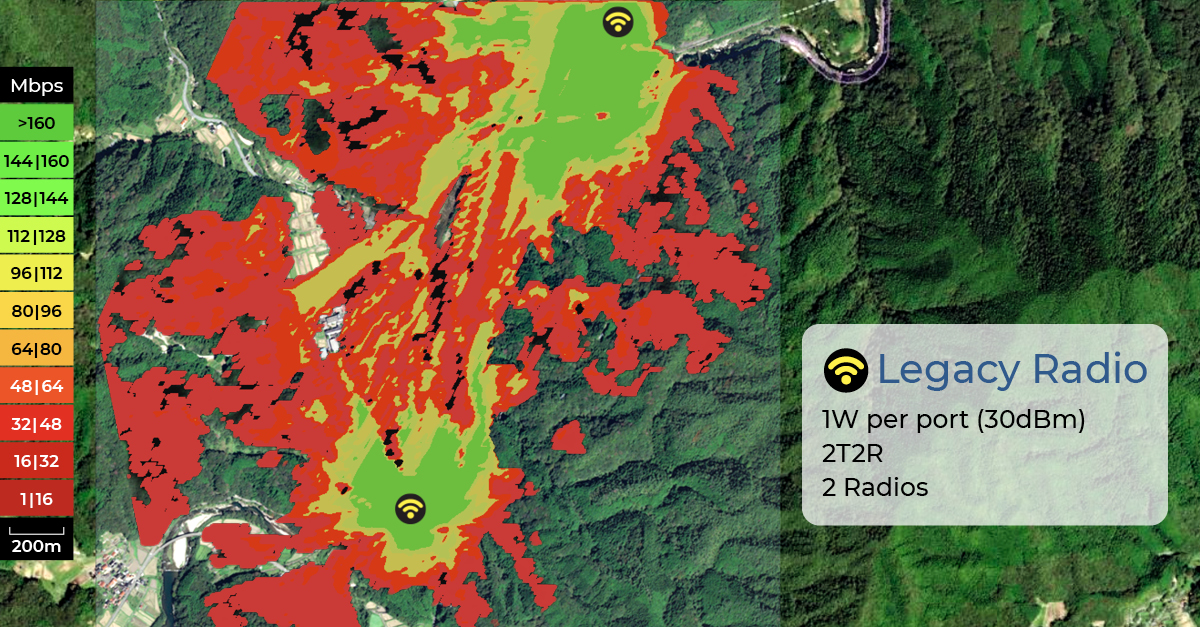
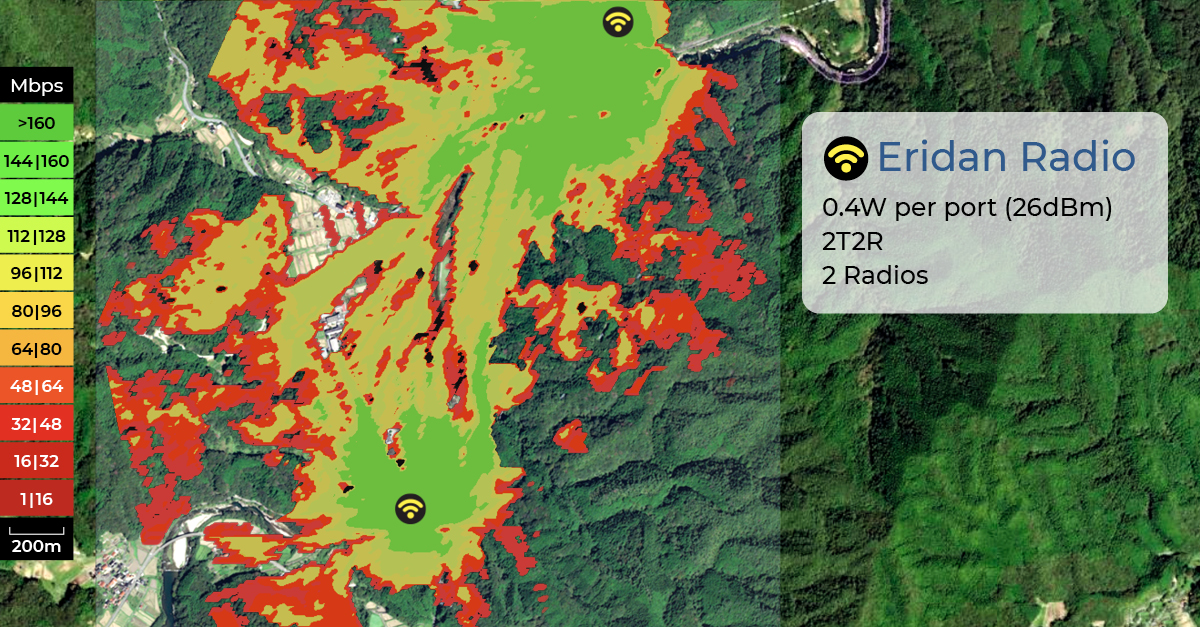
The Denser Your Network Gets, the Wider Eridan’s Performance Lead Grows
What happens when you add another cell?
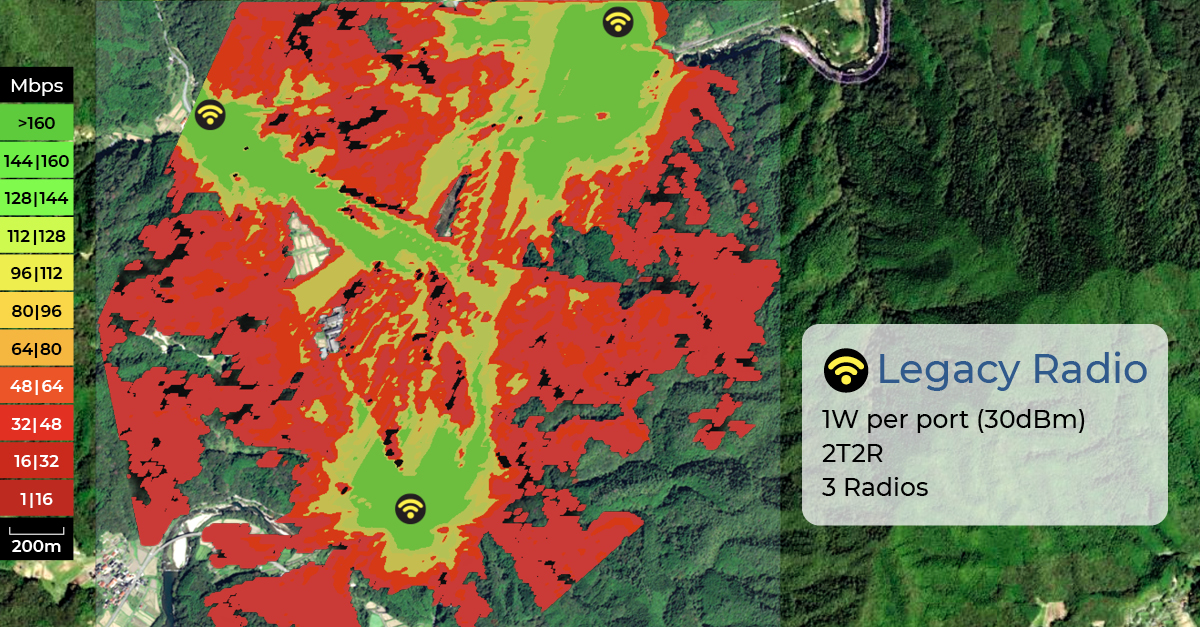
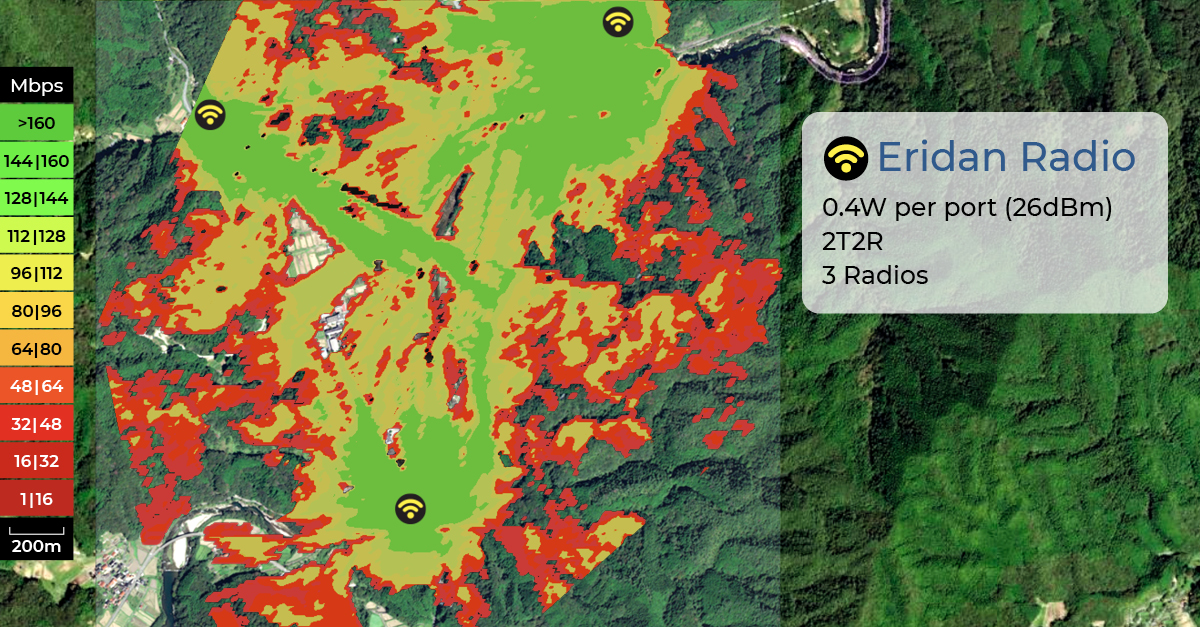
The two reduced-power legacy cells just shrunk in capacity at range, so adding a third cell is a logical next step. Not to mention demand increases! However, this third cell introduces a familiar challenge: more radios create more co-channel interference, reducing each cell’s capacity. While total network capacity increases, each additional cell delivers diminishing returns.
In comparison, adding a third Eridan radio introduces less co-channel interference due to its substantially lower power level. As a result, three Eridan radios provide 82% more high-capacity area than three 1W legacy radios.
The Long-Term Fix for Network Density
An efficiency-first approach outperforms the reactive cycle of adding cells, reducing power, and increasing co-channel interference.
- In a two-cell high-power scenario, Eridan provides 22% more high-capacity area than the legacy 5W radios.
- Reducing the power of the legacy radios mitigates co-channel interference but hurts high-capacity coverage. Eridan then provides 94% more high-capacity area.
- Adding a third legacy radio increases total high-capacity coverage, but with diminishing returns due to increased co-channel interference. Eridan continues to lead with 82% more high-capacity area.
Eridan radios thrive in dense deployments because of their fundamentally cleaner approach. This provides a long-term path for scaling current and future wireless networks.
| Deployment Scenario | Legacy Radio | Legacy Fix | Eridan Radio | Eridan Coverage Relative to Legacy |
|---|---|---|---|---|
| 1-Cell | 5W per port | - | 0.4W per port | 101% |
| 2-Cell | 5W per port | Add 2nd radio | 0.4W per port | 122% |
| 2-Cell | 1W per port | Reduce power | 0.4W per port | 194% |
| 3-Cell | 1W per port | Add 3rd radio | 0.4W per port | 182% |