
Field Test
Eridan sustaining over 100 Mbps at 1.7 km using just 0.3 Watts

Eridan’s direct polar modulation based radio delivers cleaner signals with greater efficiency than legacy systems. Built on over 40 global patents, this technology provides significantly more capacity due to its ultra-low EVM (higher signal cleanliness). Higher data rates are maintained out to the cell edge in comparison to legacy radios whose throughput drops quickly.
Our field test results highlight the real-world benefit of clean signals.
Real-World Results
In Line-of-Sight (LoS) field testing, Eridan’s radio delivered exactly as promised: high throughput, exceptional signal clarity, and reliable performance over distance—all with significantly reduced output power.
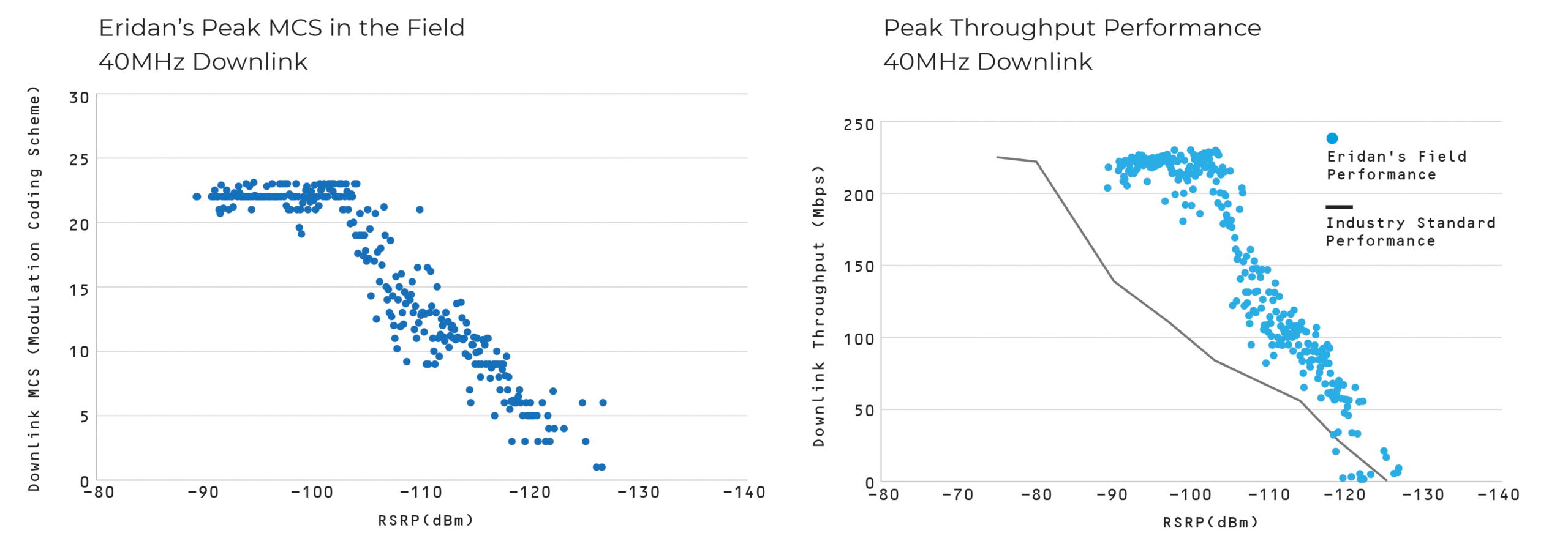
The charts above show that, at only 20MHz bandwidth and 0.3W total output power, Eridan maintains ~100Mbps out to 1km, a strong indicator of signal clarity and low EVM. The modulation coding scheme (MCS) is similarly resilient as the received signal strength (RSRP) diminishes. This highlights the benefit of low EVM in any deployment scenario: whether it is a dense, high-scatter environment or an open range, clean signals are more efficient with each Watt consumed and area covered.
All tests were conducted in LoS conditions using Eridan’s production CBRS ORAN 7.2x radio unit (20MHz bandwidth, 0.3W total output power), an OpenAirInterface gNodeB (CU/DU/core), 90 degree sector antenna, 3.6GHz spectrum, and Motorola 5G 2022 cellphone. Another benefit of Eridan’s direct polar radio technology is the small form factor, allowing the radio to be installed directly behind the antenna at the top of the 50ft mast with 24-inch low-loss RF cables.
One-to-One Comparison
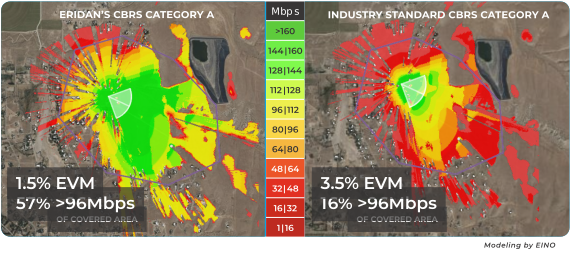
Using the collected field results and simulations developed by AI-powered networking planning firm Eino (www.eino.ai), Eridan’s CBRS Category A radio installation delivers significantly better throughput over a covered area in comparison to an identical industry standard Category A model with typical EVM.
Eridan clearly sustains higher throughput across a wider area. In approaching the cell edge, Eridan’s data rate transitions quickly from peak capacity
These heat maps show signal propagation using the same output power, 40MHz bandwidth, antenna, and DU configuration; the only difference being the fundamental signal cleanliness of the radio. Eridan clearly sustains higher throughput across a wider area. In approaching the cell edge, Eridan’s data rate transitions quickly from peak capacity (green and yellow) to minimal/no coverage (red and beyond). This visualizes the sharp relationship between MCS and RSRP; data rates stay high until the signal can no longer propagate. In comparison, the industry standard model transitions quickly out of peak capacity near the base station and the remaining covered area has reduced capacity.
While the above testing was done in a line of sight environment, Eridan’s propagation advantage, due to our Clean Signal with ultra-low EVM, has proven to be equally evident in urban and more dense environments.
Ready to take your
network farther?
Tell us more about your deployment goals and we'll show you what clean signal makes possible.